



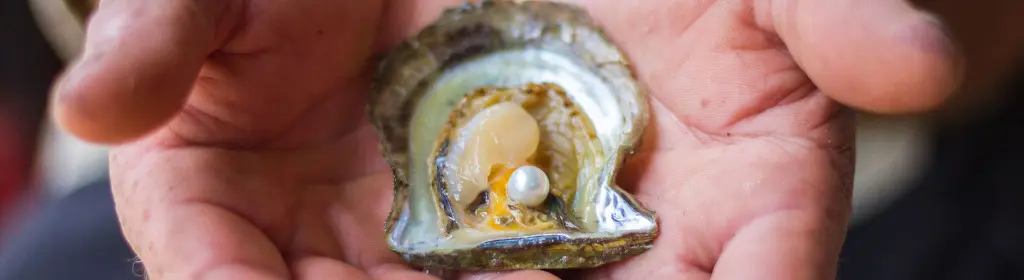

How do you tell if pearls are real?

Before we get into how you tell if a pearl is real or otherwise, let’s learn some basic terminology and understand what we mean by “real”.
Natural vs cultured pearls
When some people talk about whether a pearl is real, they might be referring to whether it was a naturally occurring pearl found in the wild, or whether it has been farmed using human intervention. As we mentioned in the article What are pearls and where do they come from? The difference between cultured pearls and natural pearls is that cultured pearls are grown on pearl farms, while natural pearls grow in the wild without human intervention. Cultured pearls are therefore the result of human intervention known as seeding; natural pearls are not. Most pearls in the pearl and jewellery markets are cultured pearls. Because natural pearls are so rare, with anywhere from 1 in 10,000 to 1 in 50,000 oysters producing such a pearl, most of the natural (non-seeded) pearls in the world are antiques.
Saltwater vs freshwater pearls
Now that we’ve established that you’re probably not going to be looking for a “natural” pearl, the next factor to be considered is whether it is a saltwater or freshwater pearl. Saltwater pearls are often, but not always, more expensive than freshwater pearls due to their scarcity. Freshwater pearls are more likely to have been chemically treated so that they can achieve their shiny look. Freshwater pearls are grown in freshwater mussels and most of them come from China, although they can be found in almost any pond, lake or river across the world. Saltwater pearls are grown in oysters living in oceans and originate from places such as Thailand, Australia, Japan, Indonesia, the Philippines and Tahiti, among others.
Both saltwater and freshwater pearls are therefore considered to be real, however, the next category is one that we will classify as fake. These are essentially beads that are made from either plastic, shell, alabaster, or glass.
Real pearls vs fake pearls
THE SURFACE OF THE PEARL
There are a few things you can do to determine if a pearl is real or not. The first thing you can do is look at the surface of the pearl. A real pearl is more likely to have surface irregularities, unless it’s very expensive, while a fake pearl often has a perfect surface. This means fake pearls will feel much smoother to the touch than real pearls, which have a gritty texture. You can also apply the tooth test to check for grittiness. This involves rubbing the pearl lightly against the front of your tooth. Remember not to rub the pearl against the side of your tooth, as this may scratch the pearl. Again, you’re looking for a gritty texture, which you won’t get if the pearl is fake.
THE COLOUR OF THE PEARL
The second thing you can do is look at the colour of the pearl. Fake pearls have a uniform colour, so if a pearl is real, what we’re looking for is a translucent overtone that could appear either green or pink over the main colour. Exceptional quality pearls may however have a uniform colour, so this factor should not be used in isolation.
THE SHAPE OF THE PEARL
The third thing you can do is look at the shape of the pearl. A real pearl can often be misshapen (baroque), so if the pearls you’re examining are perfectly round, and are either at a low price point or are being sold from a less than reputable retailer, then there is a good chance those “pearls” will be fake. Additionally, real pearls are unique in that no two are exactly alike – their shapes and sizes will vary.
THE LUSTRE OF THE PEARL
Just as we’ve seen with surface, colour and shape, the lustre (the way that the pearls radiate light), also varies with real pearls, while the fake pearls are more likely to radiate light evenly over the entire surface of the pearl. Further, the depth of lustre with real pearls is very pronounced, which gives the sense that the light is radiating from within the pearl. The lustre or lack thereof, of the fake pearls, gives the impression that this effect is shallow and only appears at the surface of the gemstone.
Fake pearls are often created using a process of moulding one of the compounds mentioned above and then coating the surface with a pearl-like substance. As a result, they are not as dense as real pearls and will usually be lighter in weight. Fake pearls may also feel abnormally heavy as they may have been given some additional weight, while the real thing will have a weight that you would have expected it to have.
THE SOUND OF A PEARL
Another way to tell the difference between fake and real pearls is by their sound. Real pearls sound less “tinny” than fake ones, which tend to resonate more hollowly. Another way to differentiate between the two is by how they react to being rubbed. Real pearls will create powder when rubbed while fake pearls will not, however, this activity will cause damage to the surface of the pearl, so we wouldn’t recommend using this as a way of determining pearl authenticity.
THE TEMPERATURE OF A PEARL
The temperature of the pearl can be a good indicator of its authenticity or otherwise. A real pearl will feel cool but will warm up once it’s been in contact with skin. Fake pearls can feel sticky and will be warm even without having been handled.
Bounce and fire tests
Let us be clear here. Do not perform the bounce or fire tests. You may come across these methods and people may have used them in the past but given there are other methods that don’t involve the potential for personal injury and/or damage to the pearl, these are not recommended. Pearls are sensitive gems that require specific care and attention, a topic we will cover in another article.
The bounce test involves dropping a pearl onto a piece of glass. If the pearl bounces more than one foot, it’s probably real. The fire test involves holding a naked flame to the pearl. The fake pearls will develop a bad odour and will lose their lustre, whereas the natural or cultured pearl produces no odour and will retail its lustre. If you keep the flame on a real pearl, after about two minutes the pearl will make a pop sound, while no such sound will be heard from the fake item.
Conclusion
If you want to be sure you can always find a specialist who can use a magnifier to quickly tell if what you have is the real thing, or whether you’re holding a strand nice looking, but plastic beads.
Pearls are beautiful and unique gems that have been prized by humans for centuries. Now that you know a little bit more about pearls, feel free to browse our collection and find the perfect piece just for you.
Do you have any questions about pearls that we didn’t cover in this article? Feel free to drop us a line or book a free 15-minute consultation with one of our experienced staff. And if you found this article helpful, be sure to share it with your friends so they can learn more about these amazing gems too!